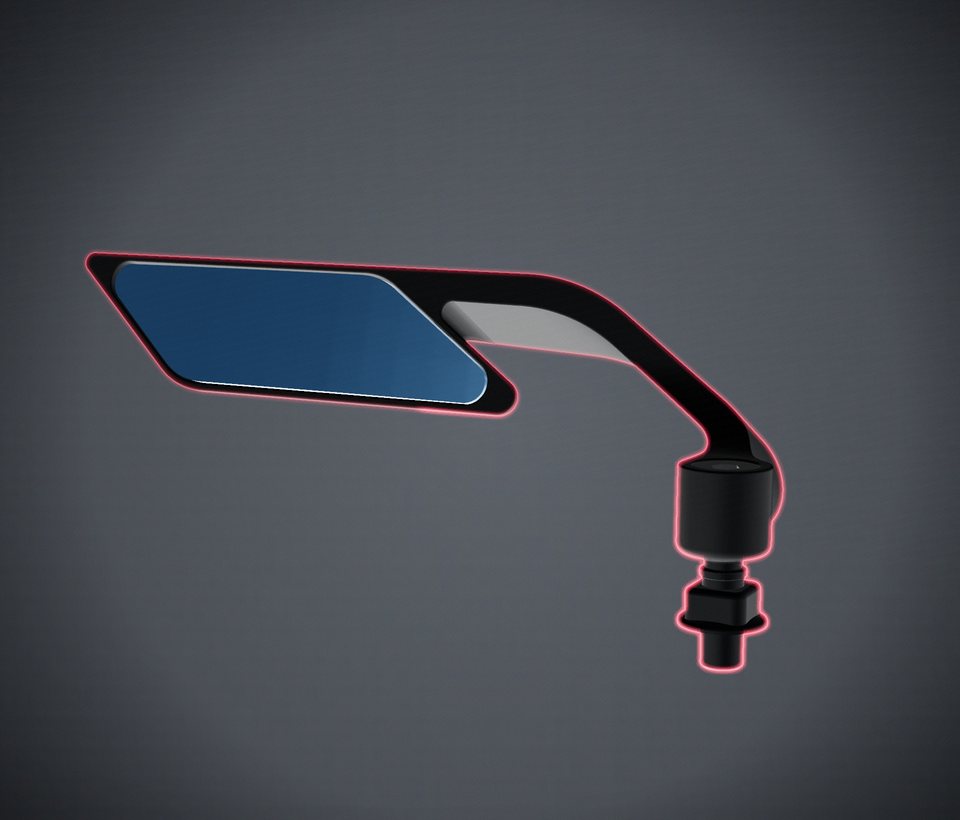
Road-legal motorcycle mirrors: what the law says
To ride on public roads, mopeds, motorcycles and scooters must have rear-view mirrors, and the mirrors must be type-approved. Here you will find, in plain words, what the rules say, how to recognise an approved mirror and how to see it on FAR product pages.
In short
- In Italy, the Highway Code (Codice della strada, art. 72) requires mopeds and motorcycles to have rear-view mirrors and the mirrors to be type-approved.
- The technical rules are in UN Regulation No 81, which the European Union makes mandatory for mopeds and motorcycles.
- Two-wheelers faster than 50 km/h must have two mirrors, one on each side; up to 50 km/h one is enough, on the left (in right-hand traffic countries).
- An approved mirror carries the mark: E in a circle with the country number (E3 = Italy), the approval number and the letter L.
- On FAR product pages the green “ECE homologated” badge marks approved products; the yellow notice marks those for track, racing or display.
What the law says
In Italy, article 72 of the Highway Code (Codice della strada) states that mopeds, motorcycles and cars must have “rear-view devices” and that these devices are subject to type approval. Anyone riding with a mandatory device that is missing or not compliant faces the penalty set by the same article (paragraph 13).
The technical rules for mirrors on two- and three-wheel vehicles without enclosed bodywork are in UN Regulation No 81 (often written “ECE R81”): ECE is the United Nations Economic Commission for Europe, which drew it up. The European Union makes it mandatory for mopeds, motorcycles and motorcycles with sidecar (Commission Delegated Regulation (EU) No 3/2014, Annex X). The regulation requires the mirror fitted to the vehicle to be approved under the same regulation.
How many mirrors you need
The number depends on the wheels and on the top speed the vehicle is built for (the regulation calls it “maximum design speed”).
| Vehicle | Mirrors required |
|---|---|
| Two wheels, up to 50 km/h (for example mopeds, which under the Italian Highway Code reach 45 km/h at most) | At least one. If there is only one, it goes on the left (in right-hand traffic countries such as Italy) |
| Two wheels, over 50 km/h | Two: one on the left and one on the right |
| Three wheels | Two: one on the left and one on the right |
For vehicle approval, the regulation also requires the mirrors to:
- stay steady in their position under normal use;
- have the centre of the mirror at least 280 mm from the vertical plane through the centre of the steering head, measured horizontally with the handlebar straight;
- be adjustable by the rider in the normal riding position.
How to recognise an approved mirror
Every mirror approved under UN Regulation No 81 carries the approval mark, which must be legible, indelible and visible even with the mirror fitted. It looks like this:
- a capital E inside a circle, followed by the number of the country that granted the approval (for example E3 = Italy);
- an approval number: the first two digits show the version of the regulation used (00 = original version);
- the letter L, the class of mirrors for these vehicles.
The example given in the regulation: an E4 mark with number 002439 and the letter L means a mirror approved in the Netherlands.
| Number | Country that granted the approval |
|---|---|
| 1 | Germany |
| 2 | France |
| 3 | Italy |
| 4 | Netherlands |
| 9 | Spain |
If a mirror has no mark, it is not shown to be approved.
Technical requirements for the mirror
To get the mark, the mirror must pass the tests of UN Regulation No 81. The main ones:
| Requirement | What the regulation asks |
|---|---|
| Mirror surface | At least 69 cm² |
| Round mirror | Diameter between 94 and 150 mm |
| Other shapes | Must contain a 78 mm circle and fit into a 120 × 200 mm rectangle |
| Glass | Convex (curved), with a radius of curvature between 1,000 and 1,500 mm |
| Reflection | At least 40 % |
| Adjustment | The mirror must be adjustable |
| Edges | Rounded, with a radius of at least 2.5 mm |
| Impact and bending tests | The mirror must not break; if the glass cracks, the pieces must stay attached (or the glass must be safety glass) |
A mirror whose reflecting surface is smaller than these sizes cannot be approved under this regulation.
Non-approved mirrors: what they are for
Some mirrors are designed for the track, racing or display, with shapes and sizes outside the regulation. They have no approval mark and are not made for public roads, where approved mirrors are required.
How to see it on the FAR website
- Green “ECE homologated” badge among the product page information: the product is approved for road use.
- Yellow notice “Not homologated for road use: intended exclusively for track or competition use.”: the product is for track, racing or display.
- If a product page shows neither the badge nor the notice, write to us before buying.
- Search by Motorcycle, at the top of every page: choose make, model and year to see only compatible products; the product page also shows the thread and mounting side.
Many FAR models come both road-approved and for the track, bar end mirrors included: always check the badge on the product page before ordering.
See rear-view mirrorsSee bar end mirrors
Frequently asked questions
Do motorcycle mirrors have to be type-approved?
Yes, to ride on public roads. The Italian Highway Code (art. 72) makes rear-view mirrors mandatory on mopeds and motorcycles and subjects them to type approval; UN Regulation No 81 requires the mirror fitted to the vehicle to be approved under the same regulation.
How many mirrors does my motorcycle or scooter need?
Two, one on each side, if the two-wheeler is faster than 50 km/h, and two on every three-wheel vehicle. Up to 50 km/h, like mopeds, one is enough, fitted on the left in right-hand traffic countries.
How do I recognise an approved mirror?
By the approval mark on the mirror: a capital E in a circle with the country number (for example E3), the approval number and the letter L. It must be legible even with the mirror fitted. If it is missing, the mirror is not shown to be approved.
Is a mirror approved in another country valid in Italy?
Yes. The number after the E only shows the country that granted the approval. Under the 1958 UN Agreement a product approved under a regulation is considered compliant in all countries applying that regulation, and the Italian Highway Code (art. 72, paragraph 11) recognises foreign approvals in line with international agreements.
What is the difference between E in a circle and lower-case e in a rectangle?
The capital E in a circle is the mark of approvals under UN regulations, such as No 81 for mirrors. The lower-case e in a rectangle is the mark of European Union approval; the country numbers are the same (e3 = Italy). EU Member States accept UN approvals in place of EU ones.
Can bar end mirrors be type-approved?
Yes, if they pass the tests of UN Regulation No 81 and carry the mark. FAR has road-approved bar end mirrors and track bar end mirrors: the green badge or the yellow notice on the product page tells you which one it is.
Can I fit non-approved mirrors on my motorcycle?
Not for riding on public roads: approved mirrors are required, and the Italian Highway Code (art. 72, paragraph 13) sets a penalty for riding with a mandatory device that is missing or not compliant. Non-approved mirrors are designed for track, racing or display.
What does the “ECE homologated” badge on FAR product pages mean?
That the product is approved for road use under the regulations of the United Nations Economic Commission for Europe (ECE); for mirrors it is Regulation No 81. If the product page shows the yellow notice instead, the product is for track, racing or display.
Sources
- UN Regulation No 81, rear-view mirrors of two-wheeled power-driven vehicles (Official Journal of the European Union L 185, 13 July 2012), points 1, 5, 6, 7, 8 and 16
- Commission Delegated Regulation (EU) No 3/2014, Article 14 and Annex X (rearward visibility)
- Regulation (EU) No 168/2013, Articles 39 and 54
- Commission Implementing Regulation (EU) No 901/2014, Annex V point 5.2 and Annex VII point 2.1 (“e” mark and country numbers)
- 1958 UN Agreement on vehicle approvals, Article 3 (text in the Official Journal of the European Union L 346, 17 December 1997)
- Italian Highway Code (Legislative Decree 285/1992), article 72 (in Italian)
- Italian Highway Code (Legislative Decree 285/1992), article 52, mopeds (in Italian)
Information guide by FAR, motorcycle mirrors and accessories since 1969, updated on 23 October 2026. The text of the rules prevails; for special cases concerning your vehicle, ask your workshop.